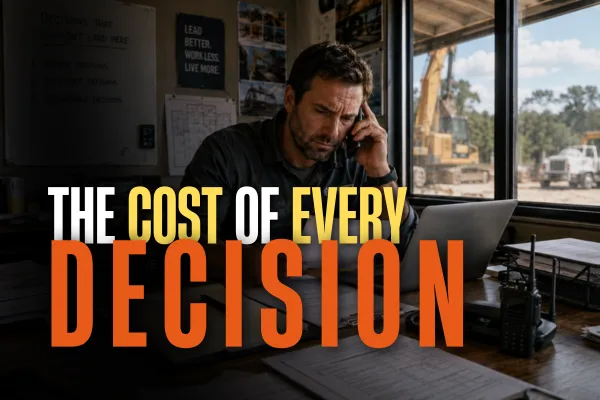
Every Decision On Your Desk Is a Missing System | 2700 Advisers
Every Decision That Lands on Your Desk Is a System That Doesn't Exist Yet
You walked in this morning with twenty things on your list.
By 10:30 you'd made nineteen decisions that weren't on it.
Pricing exception for a job you've already quoted twice.
A subcontractor wants to swap days.
Your office manager needs a call back on the insurance renewal.
Two crew members are texting about the same truck.
A customer wants to know if you'll be there personally... like always.
Every one of those decisions reaching your desk is a system that doesn't exist yet.
The decisions are the symptom.
The problem is that no one has written the process that would have allowed someone to answer it without you.
The Decisions That Should Never Reach Your Desk
When I say "your desk," of course I'm speaking metaphorically. Because you obviously don't have time to sit at a desk.
I don't mean a piece of furniture.
I mean your phone, your truck, your text thread, your inbox, the parking lot conversation, the 4:47 PM "got a second?"
The long list of places a decision finds you when there's no other home for it to go to.
Three categories of decision have no business reaching you.
The repeat decision. A choice your team has watched you make ten times. They could recite your answer. They still ask.
The rule-able decision. A choice that follows a pattern. Discounts under a certain percentage. Schedule swaps inside a certain window. Vendor approvals under a certain dollar amount. These don't need judgment. They need a rule.
The recoverable decision. A choice where the worst-case outcome is fixable. Wrong call costs you a small refund or a Tuesday. These are training ground for whoever owns that part of the work.
If the decision lands on your desk anyway, the system isn't broken. The system isn't there yet.
Why Smart Owners Confuse "Being in the Loop" With "Leading"
This is the trap.
You think you're being responsible by staying close to every call. You're being available. You're being thorough. You're being the kind of owner who cares.
A leader who answers every decision is a leader who hasn't built the next layer of the business. The decisions keep coming back because there's nowhere else for them to land. Your team doesn't lack initiative. They lack permission and a rule.
There's a tax on this you've stopped noticing. Every time you decide something a system should have decided, you pay it twice. Once in the time it takes you to decide. Once in the time it takes everything else on your list to wait its turn.
Multiply that by a week. By a year. By the version of this business you keep saying you want.
You don't have a time problem. You have a decision-rights problem.
A Decision Is Data. The Pattern Is the System.
Treat your inbox like an audit.
For one week, write down every decision that found you. Not the work. The decisions. The yes/no, the swap, the exception, the approval, the call-back.
Look at the list on Friday.
You'll see it immediately.
The same three or four decisions came at you twenty times in different costumes.
Same pricing exception with a different customer name.
Same scheduling collision with a different crew.
Same vendor question with a different invoice number.
That pattern isn't noise. That pattern is the org chart of your missing systems.
Each repeating decision is a system asking to be built. Once. So you stop deciding it forever.
The One Question That Replaces Most of Your Decisions
Here's the question that does most of the work:
"If this came up while I was on a plane, what would have to be true for it to get answered correctly without me?"
The answer always has three parts.
Outcome. What does a good answer look like? Define it in one sentence. "Customer keeps the job, margin stays above X, schedule doesn't slip more than one day."
Boundaries. What's off-limits? The lines you don't want crossed even with good intentions. "No discount above 6%. No vendor swap without a written quote. No crew change inside 48 hours of a job start."
Escalation. When does it come back to you? Define the trigger, not the topic. "Anything above $X, anything that touches the brand, anything a customer asks you to handle personally."
Outcome, boundary, escalation. Three lines. One page. Decision rights installed.
That's the system. That's the thing that wasn't there yet.
How to Start Installing Decision Rules This Week
Pick the decision that interrupted you most often last week. Just one.
Then write three rules before Friday.
Rule 1:The outcome you want every time this decision is made.
Rule 2:The boundary you won't tolerate being crossed.
Rule 3:The single trigger that brings it back to you.
Hand the page to the person closest to the work. Walk them through it once. Tell them the next time this comes up, the answer is theirs.
Then (and this is the part most owners overlook) let them make it.
Even when it's a little different than how you'd have made it. Especially then.
That's how the system gets installed. Not by writing the page. By honoring the page.
If you take the decision back the first time it feels uncomfortable, you've trained them to keep handing it up. You haven't built a system. You've built a rehearsal.
The Owner You're Trying to Become Doesn't Decide More. They Decide Less
The owner you're trying to become doesn't have a clearer head because they make better decisions.
They have a clearer head because there are fewer decisions reaching the owner's desk in the first place.
Structure does that. Systems do that. Decision rules, written once, owned by the person closest to the work... do that.
That's what "Lead Better. Work Less. Live More." actually looks like on a Tuesday afternoon.
Not fewer hours of effort.
Fewer interruptions of judgment.
Headspace, because the small calls have a home that isn't you.
You can keep being the smartest person in every conversation in your business. Or you can build a business where you don't have to be in every conversation.
You don't get both.
Ready to stop deciding the same things over and over?
Our program is built to install accountability and decision rules across your business. From pricing, scheduling, vendors, hiring, or escalation, so the decisions that should never reach your desk actually stop reaching it.
Book a free Owner Strategy Call and we'll find the three decisions costing you the most time right now and design the rules that retire them for good.