Why Smart Owners End Up as the Dumbest Part of Their Business
There’s a version of this story you probably recognize.
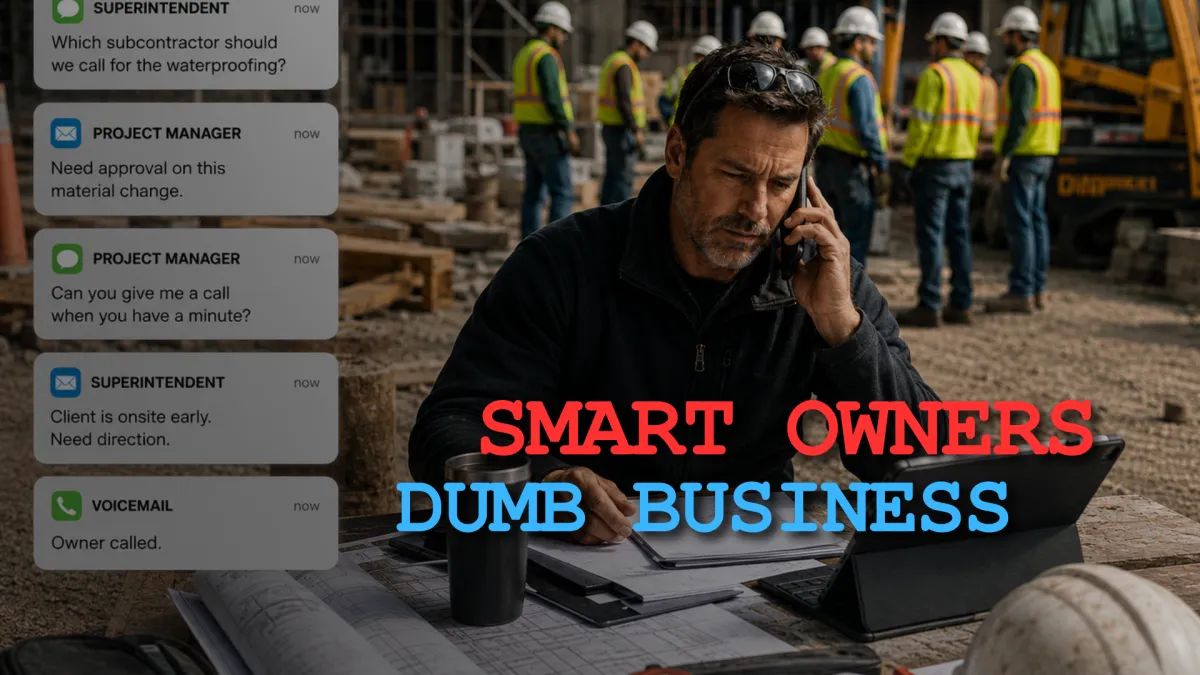
You’re on a job site.
Your phone is already blowing up.
It’s not even 8am.
Thanks for reading! Subscribe for free to receive new posts and support my work.
Someone needs to know which subcontractor to call.
Someone else needs approval on a material change.
Your project manager (and a good one at that who is paid very well) is standing in front of a decision he could absolutely make, and instead of making it, he called you.
You answer.
You tell him.
He thanks you.
You hang up.
You’ve just confirmed, again, that your business needs you to function.
This is what the business owner bottleneck looks like from the inside. Not chaos. Not failure.
Just a quiet, daily loop where the most capable person in the business keeps the whole thing moving — and nobody has to develop the ability to move it themselves.
The Competence Trap
Here’s what nobody tells you about being good at what you do.
Your competence is not neutral. Every time you solve a problem that your team should have solved, you’re training the business to route problems toward you. You’re not helping. You’re installing a dependency.
The smarter you are, the worse this gets.
You see the answer faster. You solve it cleaner. The team gets a better result when you’re involved. So the rational thing — the thing that actually works in the short term — is to stay involved. You’ve built a business where the best path forward always runs through you.
That’s the trap. And the business owner bottleneck isn’t the result of laziness. It’s the result of being good.
The Bottleneck Is You & Why It Happens to the Best Owners
You didn’t get here by being checked out.
You got here by being in.
You were the one who showed up first and left last. You were the one who knew the process better than anyone, who could spot the problem before it became a disaster, who understood what “doing it right” actually looked like. The business grew because you held the standard.
The problem is that holding the standard became the same thing as being the standard.
Now the team doesn’t make decisions, they relay them. They don’t solve problems — they escalate them. They don’t own outcomes, they wait for direction. And the business runs exactly as long as you’re available to give it.
There are three ways smart owners close down their teams without meaning to.
First:They answer too fast. The owner who responds to every text, call, and question within twenty minutes teaches the team that waiting is always worth it. Why develop judgment when the answer is a phone call away?
Second:They redo work without saying why. You review something, it’s not right, you fix it yourself and hand it back. The team sees the corrected output but never understands the standard. They get dependent on your review, not competent to meet the bar.
Third:They solve problems in public. The owner who jumps in when things get hard — who takes over the difficult conversation, the complicated job, the hard call — trains everyone in the room that hard things belong to the owner. The team learns to step back when the stakes go up.
None of this is malicious. All of it is damage.
What the Business Looks Like from the Inside
Your team isn’t slow.
They’re trained.
They’ve learned, through a thousand small interactions, that decisions flow up. That the owner’s standard is the only standard that counts. That the cost of a mistake is higher than the cost of waiting.
So they wait.
You feel like you’re the only one who cares. You’re not. You’re the only one who has been given permission to decide. There’s a difference. And until you build the structure that transfers that permission, the business is going to function exactly like a one-person operation, no matter how many people are on the payroll.
This is what owner dependency feels like from the seat you’re sitting in: exhausting, necessary, and somehow your fault, even though you can’t figure out exactly what you did wrong.
You didn’t do anything wrong. You just didn’t build the structure that would let the business run without you.
The Fix Isn’t Becoming Less Involved. It’s Becoming Involved Differently
Here’s what stopping the business owner bottleneck is not.
It’s not stepping away and hoping the team figures it out.
It’s not delegating without defining what success looks like.
It’s not handing off a problem and disappearing.
That’s not leadership.
That’s abdication.
The actual fix is structural.
You need to define, explicitly, which decisions belong at which level. Your team should own a category of decisions completely. A second category escalates to a manager. A third category comes to you. If everything lives in the third category, you haven’t built a structure — you’ve built a funnel that ends at your phone.
You also need operating rhythms your team can run without you in the room. A weekly meeting that reviews numbers, identifies problems, and assigns owners. A scorecard that tells the team whether they’re winning without waiting for your read on it. A reporting cadence that surfaces issues before they become crises.
Structure is what makes it safe for smart people to make decisions. Without it, the safest move is always to wait.
What It Looks Like When the Owner Gets Out of the Way
The business owner bottleneck breaks when the team starts making decisions you used to make — and making them well.
Not because you stepped back. Because you built the conditions where they could step forward.
You defined the standard. You built the rhythm. You installed the accountability. You coached the judgment into the people you trusted with your business.
That’s what leading looks like from the front — not solving problems, but building the structure that makes your team capable of solving them.
The business that runs on your intelligence alone isn’t a business. It’s a dependency. You deserve something that works without you in the middle of everything — and so does the team you’ve built.
If you’re ready to stop being the smartest person in the room and start being the person who built the room.
Lead Better.
Work Less.
Live More.
This is where that shift happens.
Use this link to book a call.
Zero obligation! No sales. No pitch.
Lets find out exactly where the bottleneck is in your business.