Stop Drawing Boxes. Start Assigning Ownership.
Published: 2026-08-31 | Week 14 | Theme: September — The Accountability Chart vs. The Org Chart
You've probably seen this business, or one just like it.
There's an org chart somewhere.
Maybe framed in the office, maybe just a slide from a planning session two years back.
Names, titles, boxes, lines connecting them.
It looks like a real company.
It looks organized.
Then something goes wrong.
A job runs over budget.
A client complaint sits unanswered for a week.
Payroll gets processed late two months running.
And the honest answer to "whose fault is that" is always the same: nobody's sure.
Or worse yet, everybody's sure it's the owner's, because it always ends up there anyway.
That gap between the org chart on the wall and the confusion in the Monday morning meeting is one of the most common structural holes in small business.
Its generally not because owners don't care about structure.
Its often because they built the version that's easy to draw, and stopped before they fully implemented the version that will catapult them to the next chapter in the business.
The Org Chart Everyone Has and the Structure Almost Nobody Does
An org chart is a picture of people.
It shows who's on the team and where they sit relative to everyone else.
It's useful. It's also incomplete in a way that doesn't show up until something breaks.
What an org chart doesn't do is answer the question that actually matters when a result is missing: who owns this outcome? Not who's involved. Not who's closest to it. Who is on the hook if it doesn't happen.
Most businesses never answer that question in writing.
They answer it by default, in the moment, usually with the owner absorbing it. Its because when nobody else is clearly responsible, the person who cares most steps in.
Every time.
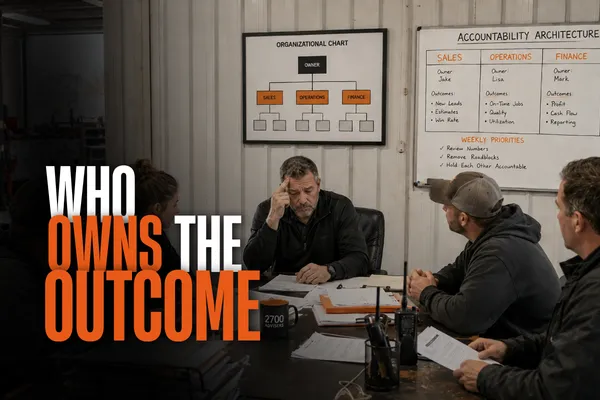
The Accountability Architecture vs. The Org Chart. What Actually Changes When Ownership Is Named
A companies accountability architecture looks similar to an org chart at a glance.
Same boxes, roughly the same names.
The difference is what's attached to each box: not just a title, but an outcome, and a person whose job it is to own that outcome... not just do tasks related to it.
Sales isn't just a department. It's a seat with a named owner responsible for whether revenue targets get hit.
Operations isn't just a group of people doing the work. It's a seat with someone accountable for whether jobs run on time and on budget.
Finance isn't just bookkeeping. It's a seat with someone answerable for whether the numbers are accurate and on time.
A Seat Is Not the Same as an Owner
A business can have every seat filled and still have no accountability architecture, because filling a seat and owning an outcome are different things. Someone can sit in the operations chair and still not be the person who's actually on the hook when a job runs over. Until that ownership is named out loud, in writing, agreed to by the person in the seat, the seat is just a box with a name in it.
How to Spot a Business That's Missing One
It's not hard to spot from the outside, once you know what to look for.
Problems get discussed by the group instead of owned by a person. Everyone has an opinion about why the last job ran over budget. Nobody's job depended on it not happening.
The same issue keeps showing up in different forms. Late invoices this month, missed follow-ups last month, a scheduling conflict the month before that. Its a different symptom, same root cause: no one's actually accountable for the function where it keeps happening.
And almost everything, eventually, lands on the owner's desk. Not because the owner is the only capable person. Because when ownership was never named anywhere else, the default owner of everything is whoever's willing to catch it.
What Changes When Ownership Gets Named
The shift isn't dramatic to watch from the outside, but it changes how a business actually runs.
Problems stop floating. When something goes wrong in a function with a named owner, there's a person to have the conversation with. Not a group, not a vague sense of "someone should look into that." But a conversation.
Results improve, often quickly, for a reason that has nothing to do with talent. People perform differently when they know a result is specifically theirs versus when they know it's everyone's responsibility, which functionally means no one's.
And the owner starts getting pulled into fewer things.
They don't have to step back necessarily. But there's finally someone else whose job it actually is to catch the problem first.
Structure Is the Answer
An org chart tells you who's on the team. Accountability architecture tells you who's actually running it.
Most businesses stop at the first one because it's easier to build and easier to defend. Nobody has an uncomfortable conversation drawing boxes and lines. Accountability Architecture requires naming, out loud, exactly who owns each result. That's a harder conversation. It's also the one that actually changes what happens the next time something goes wrong.
If you know a business where every problem seems to land on the owner's desk regardless of who's supposedly responsible for it, that's usually not a hiring problem or a talent problem. It's a missing accountability chart, hiding behind an org chart that looks complete.
Worth the Introduction
If a business came to mind while reading this... the one with the framed org chart and the owner who somehow ends up solving everything anyway... that's exactly who this was written for.
Lead Better. Work Less. Live More.
The 2700 Standard is executed with Accountability Architecture alongside the owner, seat by seat, outcome by outcome.
A free Owner Strategy Call is the easiest next step, and it's a referral worth making.