The Difference Between a Team That Executes and a Team That Waits
The Difference Between a Team That Executes and a Team That Waits
The difference between a team that executes and a team that waits has almost nothing to do with the team.
It has to do with what you wrote down. What you didn't. And what your team is allowed to decide without you in the room.
If your phone goes quiet for two hours and the work stops, you don't have a people problem. You have a structure problem dressed up as a people problem. The two look identical until you know what to look for.
This is what to look for.
A Team That Waits Isn't a People Problem
Here's the lie most owners tell themselves around year three:I just need better people.
You don't.
You have decent people. You hired them, you trained them, you pay them, and most of them want to do good work. What they don't have is permission. Not the soft kind — the actual kind. Written down. Specific. Bounded. The kind that saysyou decide this, you escalate that, and here is the line between the two.
Without that, every decision routes back to the one person whose name is on the door. That's you. And once that loop hardens, you don't have a team.
A team that waits isn't disengaged. It's a team that has correctly read the structure you gave it. They wait because waiting is the only safe move. Being wrong about a decision they were never told they could make is the fastest way to get pulled into your office. So they don't make the call. They send the text. They wait for you.
That's not a personality flaw. That's a structural read.
The Decisions That Should Never Reach Your Desk
Most of what hits your phone shouldn't.
There are three kinds of decisions that don't belong on the owner's desk in a $400K–$3M service business. They feel like leadership when you handle them. They are actually a tax on your time, and a signal that something never got built.
Repeat decisions. You've answered this one before. Same scenario, same customer type, same trade-off. If you can finish the question before the tech finishes asking it, you're not making a decision — you're broadcasting a rule that was never written down. The rule belongs on paper. The decision belongs to your lead tech.
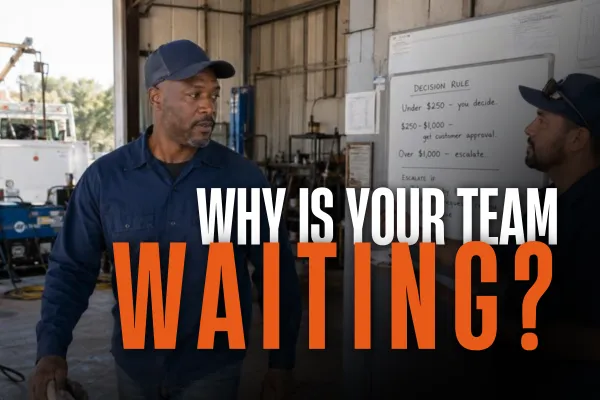
Rule-able decisions. This one has a clean line you could draw in a sentence.Under this dollar amount, you decide. Over it, you call.If the customer is repeat, do this. If they're new, do that. You haven't drawn the line yet, so every borderline case lives on your phone. A one-line rule retires forty calls a quarter.
Recoverable decisions. If your team gets this one wrong, the cost is small, the fix is fast, and the lesson sticks. These are exactly the decisions you should be letting your team make. Not because the outcome doesn't matter — because the learning does. An organization that protects its team from every recoverable mistake produces people who can't decide anything when it counts.
Look at your phone from the last seven days. How many of those texts and calls fit one of those three categories? If the answer is most of them, you don't have a busy week. You have a backlog of un-installed structure.
The Three Things an Executing Team Has
A team that executes has three things in writing. A team that waits is missing at least one.
Clear outcome. They know whatdonelooks like. Not "handle it." Not "take care of the customer." A specific, observable end state. The job is signed off, the photo is uploaded, the customer left a five-star, the invoice is closed.Doneis a fact, not a feeling.
Clear authority. They know what they're allowed to decide without asking. The dollar threshold. The discount range. The reschedule rule. The vendor swap. If they have to text you to find out whether they can spend $80 on a tarp at midnight, you don't have a team — you have a remote control.
Clear escalation. They know exactly when, and how, to bring something back up. Not "if it's weird, call me." A specific trigger. If the job goes over by 15%, escalate. If the customer asks for a refund, escalate. Anything else, decide. When the escalation rule is written, your phone goes quiet on the things it should and rings on the things you actually need to see.
Outcome, authority, escalation. Three sentences per role. That's the difference. Not personality. Not hustle. Not "ownership" as a vibe.
Install This Week: One Decision, Written Down, Returned to the Team
You don't need a reorg. You need one decision off your desk by Friday.
Pick the question you've answered the most this month. Write the answer as a one-line rule. Tell the person who should own it that they own it now, and read them the line about when to bring it back. Then don't take it back the first time they do it differently than you would have.If the outcome is in the acceptable range and the escalation rule held, the system worked. Take the win.
Do this once a week for thirty days. Four rules, four decisions returned. Within a quarter, your phone is quieter, your team is sharper, and the bottleneck you've been blaming on hiring starts to look a lot like the structure that finally got installed.
A team doesn't grow into execution by trying harder. It grows into execution because someone built the structure that allows it.
Execution Is a Structure You Build, Not a Personality You Hire
You will never hire your way into a team that executes. You can hire great people into a structure that produces waiting, and they will wait. You can also hire average people into a structure that produces ownership, and they will own.
The team isn't the variable. The structure is.
Every decision sitting on your desk this week is a system that doesn't exist yet. You don't have to build all of them. You have to build one of them by Friday. Then another the Friday after that. The difference between a team that executes and a team that waits is the owner who finally stopped answering and started writing the rule down.
If your team is waiting on decisions that should never reach your desk, the fix is structural — not motivational, not a culture talk, not a new hire. Our system installs the decision rights, operating rhythms, and chain of command that turn a waiting team into an executing one. Book a free Owner Strategy Call and we'll map your top three "waiting decisions" and the rules that retire them.