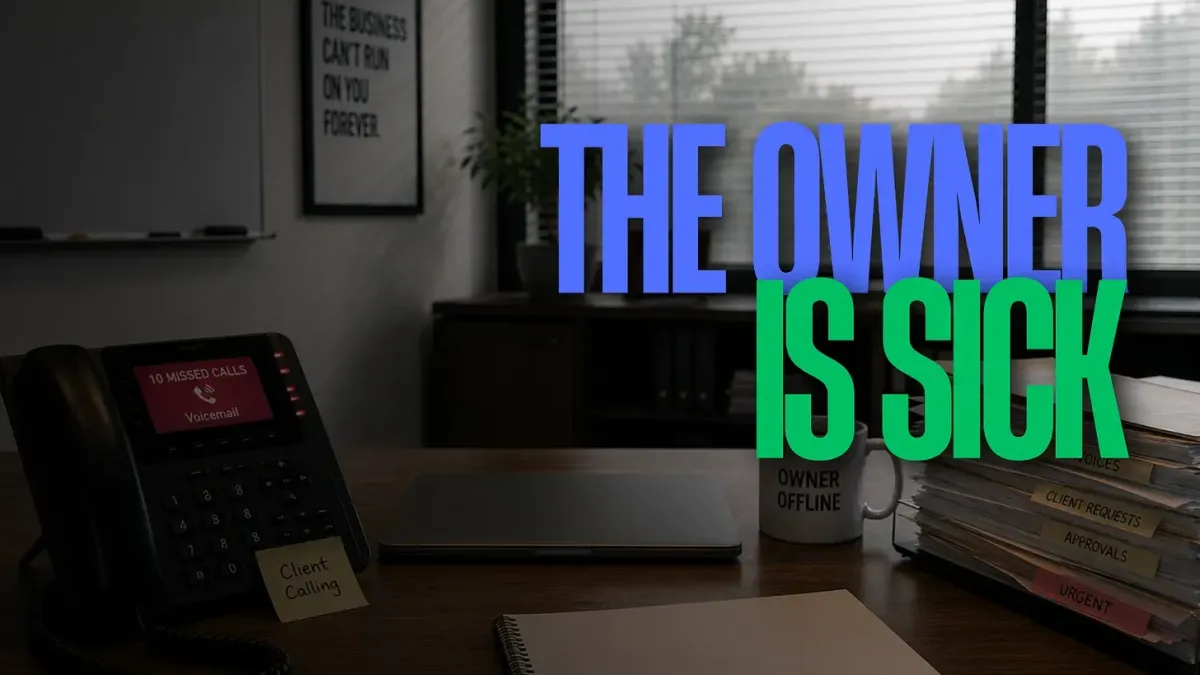
What Happens to Your Business When You Get Sick?
Imagine you woke up tomorrow and couldn’t get out of bed.
Not the man-cold version. The real one. Three full days. No phone. No texts. No quick calls between naps. Your team doesn’t know exactly what you have. They just know they can’t reach you.
What does your business look like by Friday?
If you have to think about it — that’s the answer.
What Happens to Your Business When You Get Sick
The Stress Test You Don’t Want to Take
The Bottleneck Is You — and Sickness Proves It
What Owner-Dependency Actually Costs
The Stress Test You Don’t Want to Take
The owner who gets sick learns more about their business in seventy-two hours than they’ve learned in three years.
You find out which decisions actually require you. You find out which ones your team has been quietly waiting on permission to make. You find out how thin the layer is between the work and the wallet — and how much of that layer is just you, answering quickly.
Sickness isn’t a setback. It’s an audit.
The phone rings. Then it rings again. Then the texts start. By midday Tuesday, a job that was supposed to start that morning didn’t start because nobody could approve the change order. A customer escalation got routed to your inbox, which nobody else is checking. A supplier needs a yes or a no, and your project manager is waiting on you to confirm.
By the end of day two, the cost is no longer theoretical.
The Bottleneck Is You — and Sickness Proves It
This is the part of being the bottleneck that’s hard to see when you’re healthy.
When you’re up and moving, the system looks like it’s working. You answer the calls. You make the decisions. The jobs get done. The numbers come in at the end of the week. Nobody notices that the business isn’t running — you’re running it, in real time, with your hands on every lever.
Sickness pulls your hands off the levers. And the business shows you, in plain language, what it actually is.
If it’s a real business — a system that runs because the structure runs it — a week off slows things down, but it doesn’t break them. The team makes the calls they’re authorized to make. Problems get solved at the level they should be solved. You come back to a few items that needed attention, not to a crisis.
If it’s a job with your name on it, the inbox tells the truth.
Most owners don’t want to take the stress test. So the business never gets the diagnosis it needs.
What Owner-Dependency Actually Costs
Owner-dependency is not a soft cost. It shows up in five places, and you can count it.
It shows up in revenue. Every day you’re not making the decisions your business is built to route to you, work stops. Quotes don’t go out. Jobs don’t start. Invoices don’t get sent. Cash flow has the shape of your calendar.
It shows up in your team. Capable people get demoralized when they can’t actually exercise the capability you hired them for. They stop trying to solve the hard problem because the hard problem isn’t theirs to solve. Over time, you lose them — or worse, they stay and stop developing.
It shows up at your dinner table. The vacation you didn’t take. The dinner you took on the phone. The Saturday that turned into a job site visit because there was nobody else to call. The business doesn’t get to be the only thing that gets the best of you.
It shows up in valuation. A buyer pays for a business. They don’t pay for a job that depends on the seller showing up. If you’ve built something with the intent of someday selling it, owner-dependency is a discount applied to the price, in writing, by every buyer who knows what they’re doing.
And it shows up in your health. The body that’s been running a business by itself eventually sends a bill.
Building a Business That Survives a Week Without You
The fix is not heroic. It’s structural.
You need three things installed before the next time you get sick — not after.
First: defined decision rights. Your team should know, on paper, which decisions are theirs to make completely, which escalate to a manager, and which actually require you. If everything currently funnels to your phone, you don’t have decision rights — you have a queue with your name on it. Define the queue out of existence.
Second: operating rhythms that don’t require your presence. A weekly meeting that reviews the numbers, surfaces problems, and assigns owners. A scorecard the team can read without your interpretation. A reporting cadence that puts the right information in front of the right person on the right day. These are the rails that let the business run while you’re not on it.
Third: a chain of command that holds when you’re not in the room. One person who can step in and make the call. They know they’re authorized. The team knows it too. The chain doesn’t have to be elaborate. It has to exist, and it has to be honored.
This is what owning a business looks like instead of holding a job inside one.
The Honest Question to Ask Yourself This Week
You don’t have to wait for sickness to take the stress test.
Pick a week. Block your calendar. Tell your team you’re unavailable for five business days unless something is genuinely on fire. Then watch what happens.
You’ll learn more about your business in those five days than you’ve learned in five years.
You’ll find out which decisions actually need you, and which ones never did. You’ll find out which systems are real, and which ones live inside your head. You’ll find out exactly where the structure is missing.
That information is the most valuable thing your business can give you right now.
Because the business that can survive a week without you is the business that’s worth having. The business that can’t is the one that’s slowly costing you the life you started it for.
The S3 program is designed to give owners the confidence to stop being the single point of failure in their own business and start building something their team and their family can actually count on. If sickness is the audit, structure is the answer.
Book your free Owner FIT Call and find out exactly what your business would do without you next week.