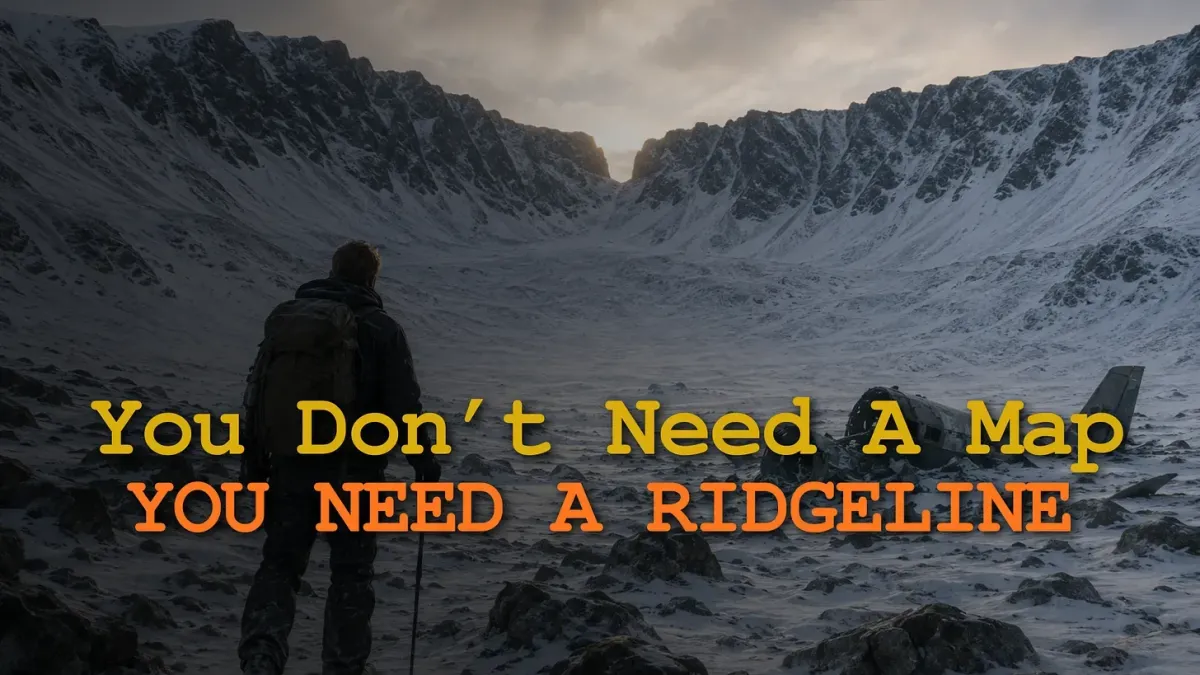
You Don't Need a Map. You Need A Ridgeline.
There’s a video I keep thinking about.
Outdoor Boys. Luke hikes into a frozen valley to find the wreckage of a US Air Force plane. Before he sets off, he picks a gap in the ridgeline across the valley. That’s his aim. That’s his crossing point.
Then he walks.
The terrain shifts under him. He adjusts. Boulders, ice, drifts.. he picks his way through what’s right in front of his boots. But his eyes keep coming back to that same gap in the ridgeline.
He never stops to map the whole route.
He couldn’t if he wanted to.
There’s wisdom in pondering the path of your feet.
Real wisdom.
But there’s a version of pondering that turns into paralysis. Where the field glasses come out and never go back in the pack. Where the map gets studied so long the daylight burns off and you never take the first step.
I know that version.
I’ve lived in it.
Here’s what most guys get wrong about clarity.
They think clarity means figuring out the whole path before they move.
It doesn’t.
Clarity is fixing the aim.
The path is figured out one step at a time, with your boots on the ground, looking at the terrain that’s actually in front of you — not the terrain you imagined from a thousand yards back.
You can’t see what you haven’t walked yet.
No amount of staring at the valley from the trailhead changes that.
So what’s the aim?
The aim is the conviction underneath the plan.
It’s not “open a second location by Q3.” That’s a path.
The aim is the ridgeline.
Why are you in this business. What kind of man are you trying to be. What does your family need from you in this season. What does a life well-lived actually look like for you — not your neighbor, not your competitor, you.
That’s the gap in the ridgeline.
When you have that locked in, the path becomes negotiable. Adjustable. You can take the long way around a boulder without feeling like you’ve lost the plot. Because the aim hasn’t changed.
The path changes.
The aim doesn’t.
Most business owners I work with aren’t stuck because they lack a plan.
They’re stuck because they don’t have an aim.
So every decision feels like the decision. Every hire feels like a referendum. Every pricing move feels like a coin flip. They’re trying to navigate without a ridgeline, which means every rock in the path looks like a mountain.
Get the aim right. The path gets simpler.
Not easier.
Simpler.
Here’s the part the leadership books skip.
Moving and adjusting only works if you’re paying attention.
Otherwise you’re just wandering with confidence.
There’s a difference between adjusting because the terrain demands it and adjusting because you got spooked. Between changing course because something true came into view and changing course because your legs got tired and your pride needed a story to tell.
You have to be able to tell the difference.
That takes quiet. It takes honesty. It takes being willing to hear what you don’t want to hear from the people you trust — and from your own conscience when it’s telling you something you’ve been ignoring.
The aim is set in the quiet.
The path is walked in the noise.
The adjustments come from listening hard while you move.
If you’re sitting at the trailhead right now with the field glasses up — staring at a decision you’ve been chewing on for six months — ask yourself an honest question.
Are you discerning?
Or are you tarrying?
Because there’s a point where the pondering stops being wisdom and starts being fear in a robe.
You don’t need to see every step.
You need to see the ridgeline.
Then move.
Adjust as you go.
Listen as you walk.
The valley is crossed by men who walked it, not by men who studied it from the rim.
Pick the gap.
Take the step.
Trust that the aim you’ve set was set for a reason — and that the terrain ahead can only be learned by walking it.