When Everyone Is Responsible, No One Is
In this note
- The Work That Belongs to Everybody
- One Result. One Owner.
- A Box on the Chart Isn't Ownership
- You Probably Don't Need to Blow Up Your Org Chart
- That Hesitation Is the Leak
- The Diagram Isn't the Win
- How to Fix Ownership Before It Fixes You
- Where the Problem Starts
- Let's Build a Business That Doesn't Depend on You
Nobody dropped the ball. But that's exactly what the problem is.
Something didn't get done.
You ask who had it.
The office thought operations was on it.
Operations figured someone already followed up.
Nobody ignored the thing.
Nobody decided it didn't matter.
Everybody's got a reasonable story.
And the result is still the same.
Nothing happened.
For a long time I'd look at that and think we've got a people problem. Somebody needs to communicate better. Pay closer attention. Step up.
Sometimes that's true. But I've started to notice it's usually something else.
Most of the time it's not an effort problem. It's a business ownership problem.
The Work That Belongs to Everybody
Every business has a handful of jobs that live in a fog. Nobody would say they're not responsible for them. But nobody could look you in the eye and say they own them either.
A follow-up call sits for three days. The equipment inspection gets pushed another month. The new-hire checklist is something everybody knows should happen, and nobody's sure whose job it is to make sure it does. Invoices age while everybody assumes accounting has eyes on them.
None of this is hard work. It falls apart because the job exists but nobody's name is actually on it.
For a while I thought the fix was more communication. More reminders. More checklists. More meetings.
Those help some. But none of it matters if everybody still walks out of the room assuming somebody else has it handled.
Shared responsibility sounds like teamwork. Most of the time it's just fog. And fog stays invisible right up until something important gets dropped.
One Result. One Owner.
Sounds too simple to work. It's not. Most owners just haven't done it yet.
A Box on the Chart Isn't Ownership
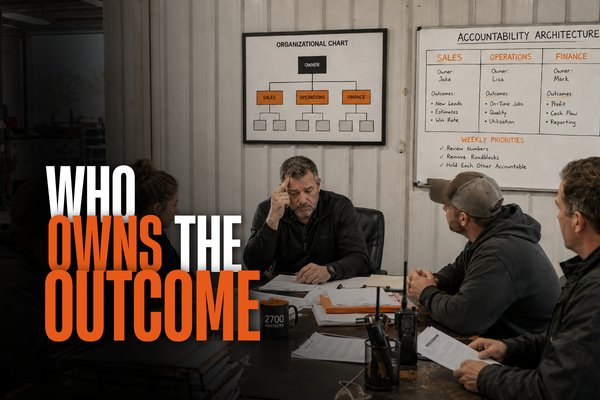
Most companies eventually build an org chart. Boxes, titles, reporting lines. It tells people who answers to whom.
The thing is, it answers a question that isn't the one costing you money.
An org chart answers: Who does this person report to?
The question you need answered is different: Who owns this result?
Who owns scheduling?
Who owns closeout?
Who owns collections?
Who owns the customer walking away happy or pissed off?
Who owns fixing it when it breaks?
A normal org chart quits doing its job right about here.
You can have clean reporting lines on paper and still have three people "helping" with scheduling. You can have an office manager, an ops manager, and a project manager all touching job closeout, and not one of them actually carries it.
Things start slipping right there.
What I keep coming back to is that a lot of owners make it worse without meaning to. They hand somebody a result without handing them the authority to go with it. You tell somebody they own it, but they still have to come ask you before they can make a real call.
At that point they don't own anything. They're just the one who catches the blame when it goes sideways.
Ownership takes two things that have to travel together: clarity on the result and enough authority to actually move on it.
You Probably Don't Need to Blow Up Your Org Chart
When owners hear this, the first instinct is to think big. New titles. New departments. Redraw the whole chart.
I'd start smaller than that.
Make a list. Not a list of people. A list of the results your business has to hit every single time.
Customer acquisition.
Scheduling.
Job execution.
Closeout.
Collections.
Vendor management.
Onboarding.
Whatever keeps your shop running.
Now put one name next to each one.
Some of them you'll nail right away. Obvious answer.
Then you'll hit one and the room goes quiet.
"Well, Sarah kind of handles that."
"Mike usually jumps in."
"I think accounting does most of it."
That Hesitation Is the Leak
In a small shop, one person can own several results, and that's fine. What matters is that every result that matters has somebody who can look you in the eye and say, that's mine.
I'm becoming more convinced you have to make them say it out loud. It matters more than it sounds like it should.
A spreadsheet can say Sarah owns collections. That doesn't make it true. It doesn't become real until Sarah understands the result, accepts it, and knows exactly what authority she has to go do something about it.
Once you start having these conversations, you'll find things that have been running for years with no real owner at all. Some of it's even working.
For now.
Worth worrying about a little.
Sometimes a process runs fine because the structure is solid. Sometimes it just looks fine because one good employee has been quietly holding it together with duct tape and overtime.
Those two things look identical from where you're standing. They are not the same.
The Diagram Isn't the Win
The goal was never a pretty diagram. That's just a tool.
What matters is the Accountability Architecture behind it: clear Seats, clear ownership, and enough authority for people to actually carry the results assigned to them.
What matters is what changes once ownership gets clear.
Decisions start moving on their own. You stop getting copied on every scheduling text because somebody else actually owns scheduling. Problems get caught earlier because one specific person is watching that result, not everybody watching it a little.
People quit asking, "Who was supposed to do that?"
And slowly, the business stops routing every loose end back to your desk.
How to Fix Ownership Before It Fixes You
Any job without a clear owner eventually lands back on you. Maybe not today. But it will.
The customer complaint gets escalated to you. The overdue invoice lands in your inbox. The scheduling conflict gets forwarded up. Somebody texts you at 9 p.m. because nobody in the building has the authority to make the call.
You end up carrying half the business without ever deciding to.
Not because you refused to delegate. Because the company never got clear on what "handed off" actually meant.
The goal isn't just getting things off your plate. It's building a company where the important stuff has somewhere else to live.
Somewhere clear. Somewhere accountable.
Where the Problem Starts
If things keep slipping and you've got good people working hard, don't start by blaming the people. Look at the ownership first.
Pick three important jobs in your business and ask one question.
Who owns the result?
If the answer is two people, a department, or "it depends," you found where the problem starts.
Let's Build a Business That Doesn't Depend on You
This is the work I do with service business owners at 2700 Advisers. Clarify ownership, define who has authority to decide what, and build the structure that lets the business run without you holding it up.
If that's what you're after, start with an Owner FIT Call.
BOOK YOUR FREE OWNER FIT CALL →