Why Your Team Keeps Bringing You Decisions

In this note
Published: 2026-09-07 | Week 15 | Theme: September - Accountability Architecture
Your phone rings.
One of your managers needs approval on a customer issue.
Five minutes later, someone wants to know if they can spend $600 on something the job needs.
Then a project manager calls because a technician made a decision in the field and nobody is sure whether he should have.
None of these decisions are especially complicated.
None of them really require the owner.
But somehow, they all end up with you.
And after a while, you start wondering whether you have the wrong people.
You probably don't.
You may have built a business where nobody is quite sure how much authority they actually have.
The Problem Usually Isn't That Your Team Won't Make Decisions
Most employees learn pretty quickly what happens when they make the wrong call.
Spend money you weren't supposed to spend.
Promise something to a customer you weren't supposed to promise.
Change the scope.
Move somebody's schedule.
Give a refund.
Call in extra labor.
Make the wrong decision once and get corrected for it, and the safer move next time is obvious:
Ask the owner.
So they do.
Again and again.
Eventually, you become the approval system for the entire company.
Your team is not incapable.
Because the business never clearly answered three questions:
What can I decide?
When do I need help?
Who do I go to next?
If those answers aren't clear, everything moves uphill.
And eventually, uphill means you.
This Is Where Most Org Charts Fall Short
A lot of businesses have an org chart.
Operations Manager.
Project Manager.
Office Manager.
Technicians.
Sales.
Admin.
The boxes are there. The titles are there. But a title doesn't automatically give someone authority.
You can call somebody the Operations Manager and still require them to check with you every time a job goes sideways.
You can call someone the Office Manager and still have every upset customer passed straight to you.
You can put someone in charge of a department and still make every financial decision for them.
That creates one of the most frustrating situations in a growing business:
Responsibility without authority.
You expect the manager to own the outcome, but you haven't clearly told them what they can decide to get there.
So they keep asking.
And you keep answering.
Look at Your Last Five Interruptions
Forget the org chart for a minute.
Think about the last five times someone interrupted you for a decision.
Maybe it was:
"Can we give this customer a credit?"
"Can I order this equipment?"
"What should I do about this employee?"
"Can we move this job?"
"Do you want me to approve the overtime?"
Now ask a different question:
Did that decision actually require me?
Some decisions will.
Big financial commitments.
Major personnel decisions.
Legal exposure.
Safety issues.
Strategic relationships.
Those belong with the owner.
But a lot of the decisions owners make every week aren't owner decisions at all.
They're decisions that landed on the owner because nobody ever established where they were supposed to stop.
Give People a Lane
One of the simplest things you can do is establish a decision threshold.
That means your people know where their authority begins and ends.
Your office manager might be able to resolve customer issues up to $500 without calling you.
Your project manager might be able to approve overtime up to a certain number of hours.
Your field lead might be able to purchase materials up to a set amount.
Your operations manager might be able to move people, adjust schedules, or make production decisions without asking permission.
The specific numbers aren't the important part.
The clarity is.
When people know where their lane is, they can move.
When they don't, they wait for you.
Then Give Them Somewhere to Go
There will always be decisions that exceed someone's authority.
That's normal.
The problem is when the next stop is automatically the owner.
A technician shouldn't necessarily escalate straight to you.
Maybe the technician goes to the crew lead.
The crew lead goes to the project manager.
The project manager goes to the operations manager.
And only certain decisions make it from there to you.
That is a real chain of command.
Not a collection of titles.
A path for decisions.
And when that path is clear, fewer things jump straight from the front line to the owner.
The Hard Part Is What You Do Next
You can write all of this down tomorrow.
That doesn't mean your team will instantly stop calling you.
They've been trained to call you.
And, whether you meant to or not, you've probably helped train them.
Someone asks a question.
You know the answer.
It takes thirty seconds.
So you answer it... Problem solved.
Except the business learned something:
When you're unsure, ask the owner.
Breaking that habit requires a different response.
When someone brings you a decision they already have the authority to make, you send it back.
"What do you think we should do?"
"Is that inside your decision threshold?"
"Who should handle this before it gets to me?"
At first, that feels slower than just giving them the answer.
It is.
But answering the question takes thirty seconds today and another thirty seconds next week.
Teaching someone where the decision belongs can remove the question entirely.
This Is How Owners Accidentally Become the Bottleneck
Most owners don't wake up and decide to make every decision in the company.
It happens gradually.
You start the business.
You're the only one there.
Every decision belongs to you.
Then you hire people.
Then managers.
Then more employees.
But the decision-making structure never grows with the headcount.
So the company gets bigger while authority stays concentrated in the same place.
With you.
Eventually you have ten or twenty people working for the business, but the organization still behaves like a five-person company.
Everybody is waiting on the same person.
That's when the owner starts saying things like:
"I can't get away."
"My people won't make decisions."
"Everything still comes back to me."
"I thought hiring managers would fix this."
Hiring managers doesn't fix it.
Giving managers clearly defined ownership, authority, and escalation paths does.
Start Here
Take the last five decisions your team brought you that probably didn't require you.
Write them down.
Then ask:
Who should have made this decision?
What authority were they missing?
Where should it have gone if they couldn't handle it?
Do that exercise often enough and you start seeing the structure your business is missing.
That's what we build inside the 2700 Standard.
Not an org chart that looks good on the wall.
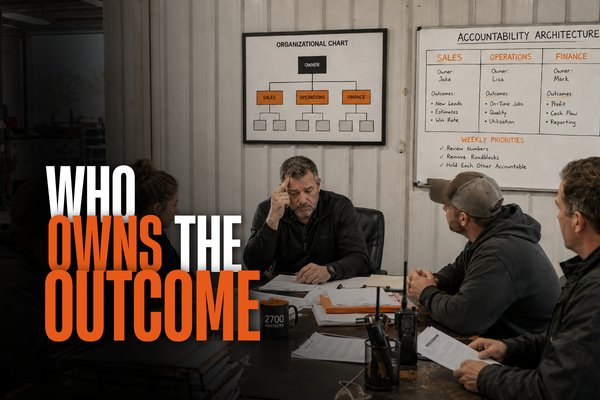
An Accountability Architecture that makes it clear who owns what, what they can decide, and where decisions go next.
Because the goal isn't to build a business where nobody ever needs you.
The goal is to stop being needed for things that never should have required you in the first place.
And that's usually where getting your time back begins.