A Bigger Business Can Still Be Completely Dependent on You
In this note
A company can have roughly 150 employees and still depend on one person.
I was recently talking with a business broker. He had been working with an owner whose company had grown to that size. On paper, most owners would call it a success. But the business still needed him too much. Important decisions still found their way back to him. Context lived in his head. Certain relationships still needed his personal touch, and people who were fully capable of leading still looked to him to settle the question whenever the answer wasn't obvious.
If he disappeared for a month, the company probably wouldn't collapse on day one. But the friction would show up quickly.
That's owner dependency at scale.
Growth didn't eliminate it.
Growth just made it harder to see.
Growth Is Not the Same Thing as Capacity
We usually measure growth with revenue, headcount, locations, customers, or market share. Those things matter. But none of them tell you whether the business can operate without the owner being involved in normal day-to-day decisions. That requires capacity, which is the business's ability to produce decisions, work, and results consistently without routing everything back through one person.
When growth outruns capacity, the owner gets busier as the company gets bigger. At five employees, owner dependency looks like constant interruptions. At fifteen employees, it looks like managers asking for approval, employees skipping the chain of command, and problems landing back on the owner's desk after everyone else has already touched them. At 150 employees, it can look more sophisticated. There may be a leadership team, managers, dashboards, and a full calendar of meetings. But if the final answer still has to come from the owner, the underlying problem hasn't changed. The business got bigger, and the owner is still the operating system.
The Simplest Owner-Dependency Test I Know
You don't need a complicated assessment to see where your business depends on you. Start with two pages.
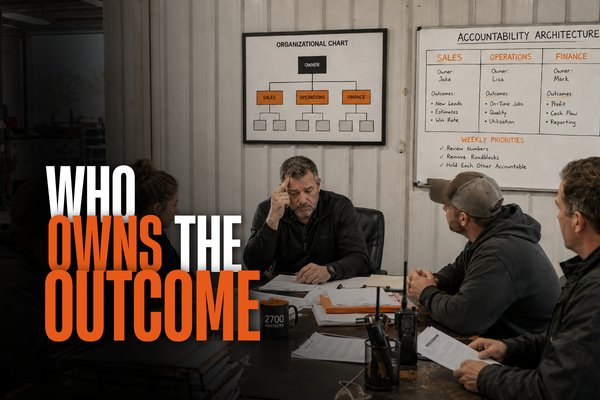
Page 1: Who owns the outcomes? List the critical functions in your business. For a service company, that might include sales, operations, finance and accounts receivable, customer experience, people and hiring, business development, and production or field performance. For each function, answer four questions:
- Who is accountable for the outcome?
- What decisions can that person make without asking you?
- What number tells you whether the outcome is healthy?
- What happens when the number is off track?
This exposes owner dependency fast. If your name appears in every row, you have a structure problem. If someone else's name is in the accountability column but they still need your permission to make normal decisions, you have an authority problem. If everyone agrees someone owns the function but nobody can name the number that proves the outcome, you have a measurement problem. And if the answer to "what happens when it's off track?" is basically "the owner gets involved," your business still depends on rescue.
Page 2: How does the business actually run? Now look at the operating rhythm. For each critical function, write down the weekly metric that gets reviewed, the recurring process that produces the result, where that process is documented, the meeting or cadence where performance gets discussed, where Friction Points get captured and resolved, and who owns the next action when something is off track.
Then ask yourself one uncomfortable question: if I went completely dark for one week, where would the team stall first? That answer usually tells you more than the org chart ever will.
Four Places Owner Dependency Usually Hides
1. Tasks were delegated. Authority was not.
This is one of the most common patterns I see. The owner says, "I delegated that." And technically, they did. Someone else is doing the work. But the owner still approves the price, the schedule, the hire, the exception, the customer resolution, the purchase, or the final decision. That isn't full delegation. That's task distribution with centralized authority.
If a manager is accountable for a result, that person needs enough authority to produce the result inside clearly defined boundaries. Otherwise the business creates an approval loop that trains everyone to wait.
2. The numbers exist, but they don't drive behavior.
Most established businesses have plenty of numbers. The problem isn't access to data. The problem is whether the right people own the right numbers and review them often enough to act on them.
Imagine two employees doing similar work. One is producing 78% gross profit while the other is producing 54%. That difference matters. But if the company only sees it after the month closes, or if nobody owns the metric, the information doesn't create accountability. More volume won't fix that inconsistency. It will scale it. A useful scorecard should tell the leadership team where to look before the owner has to explain what feels wrong.
3. The answer still lives in someone's head.
Every business has tribal knowledge. The real question is how much of the company's normal operation depends on it. If employees have to ask the same person how to handle the same situation again and again, the business doesn't have a people problem. It has a system problem.
Core processes, decision rules, standards, and training should give capable people a reliable way to act without hunting down the person who remembers how it was done last time. Documentation isn't bureaucracy. Done well, it's how you stop making the same decision over and over.
4. The weekly rhythm only works when the owner drives it.
A company can have meetings and still be owner-dependent. If the owner has to set the agenda, interpret every number, surface every Friction Point, push every decision, and chase every follow-up, that meeting isn't a leadership system. It's just another place where the owner carries the company.
A healthy weekly rhythm makes the work visible without depending on the owner's memory. The team should know the numbers, review priorities, surface Friction Points, make decisions, and leave with clear seven-day actions. The owner may still be in the room. The system shouldn't depend on the owner to make the room function.
Build the Capacity. Then Grow.
This is where a lot of businesses get the order backward. They try to grow their way out of owner dependency with more leads, more people, another location, another service line, and more revenue. But growth puts pressure on whatever operating system already exists.
If accountability is unclear, growth creates more confusion. If managers lack authority, growth creates more approvals. If processes are inconsistent, growth creates more variation. If the owner is the communication hub, growth creates more messages. And if the owner is already rescuing the business, growth just creates more things to rescue.
Capacity has to come first. That means clear structure, then systems that make the structure usable, then enough repetition for those systems to become stable. Structure → Systems → Stability → Freedom. That's the order, and growth becomes much healthier when the business has the capacity to absorb it.
Freedom Doesn't Mean the Business Never Needs You
The goal isn't to become irrelevant to your own company. The goal is choice. Can you attend your kid's event without checking your phone every five minutes? Can you take a long weekend without spending the first day preparing everyone for your absence and the last day cleaning up what happened while you were gone? Can you spend time on strategy, relationships, or growth because you chose to, instead of spending every day wherever the latest problem pulled you?
A healthy business may still benefit from the owner. It just shouldn't require the owner for normal operation. That distinction changes everything. A business that depends on you for every important decision is a job with a lot of overhead. A business with real capacity becomes an asset.
If you're over $1M in revenue, have five or more employees, and still feel like every important road leads back to you, that's the work we do at 2700 Advisers. A Fit Call is a short conversation to see where the dependency is showing up and whether we're a fit to solve it together.
Lead Better. Work Less. Live More.